The numbers are difficult to fully absorb until they're set out:
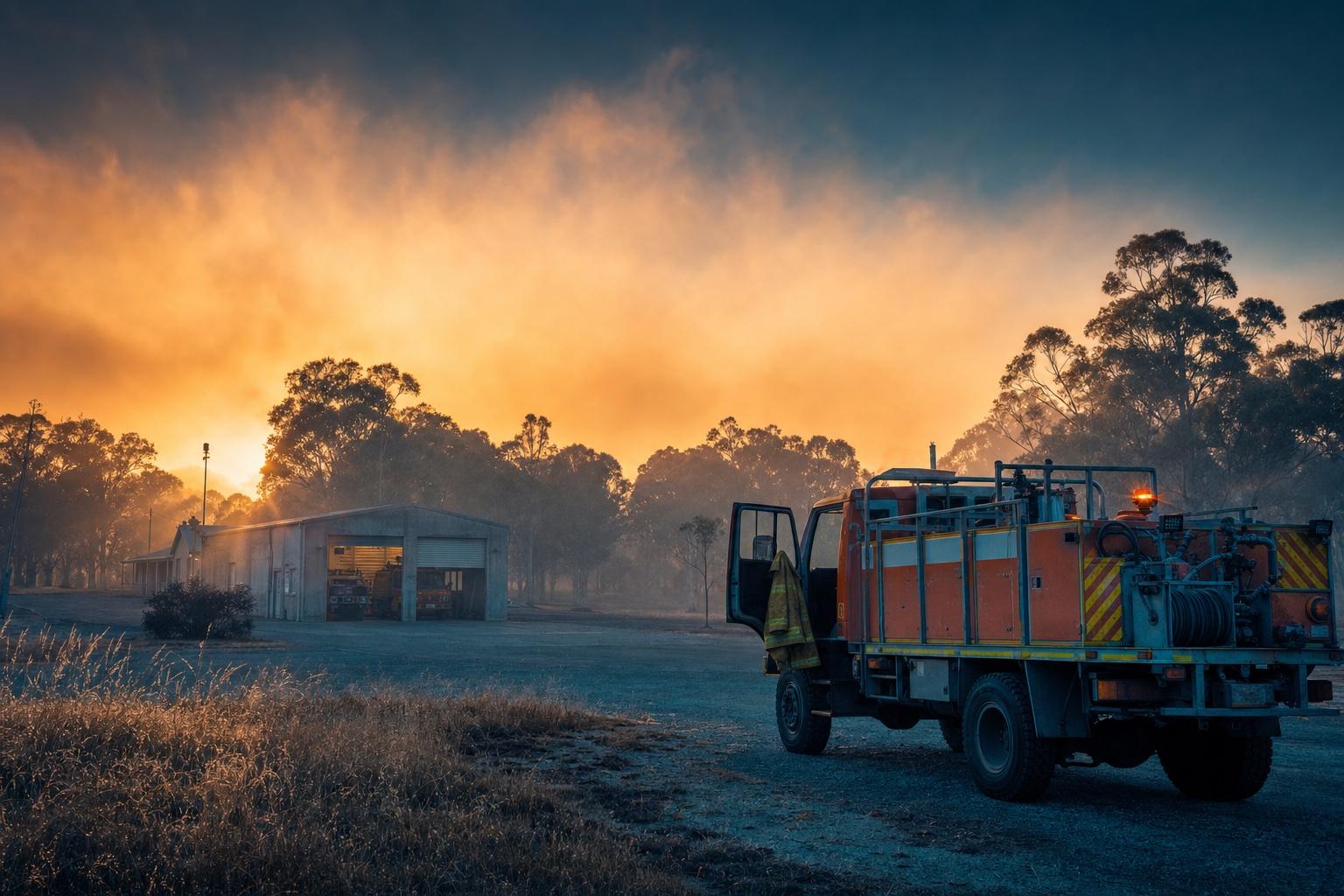
- The NSW Rural Fire Service is the largest volunteer fire service on the planet. Its operational workforce is more than 70,000 volunteers across almost 2,000 rural fire brigades, supported by 1,200 paid staff who run the District Fire Control Centres, Area Commands, and headquarters at Sydney Olympic Park.
- The NSW State Emergency Service in 2025 — its second-busiest year on record — responded to more than 60,000 incidents at an average of 1,100 a week. Volunteers contributed 860,000 hours of service. 2,300 new volunteers joined during the year. Operationally, the year included Tropical Cyclone Alfred, record flooding on the Mid North Coast and in Western NSW, and severe storms across Sydney, the Hunter, the Riverina, and the Northern Tablelands.
- Across the rest of Australia, the same shape repeats: Country Fire Authority (Vic) ~52,000 volunteer firefighters; Queensland Fire and Emergency Services (QFES) Rural Fire Service ~31,000; Country Fire Service (SA) ~13,000; Tasmania Fire Service ~5,000; CFA-equivalent volunteers across the NT and the ACT.
The combined Australian volunteer emergency-services workforce is, conservatively, around 200,000 people. They are spread across thousands of brigades and units, mostly in regional and remote areas, mostly working in their own time on their own terms with their own gear, mostly led by volunteer captains and lieutenants who hold day jobs as plumbers, accountants, farmers, and teachers.
This is the largest distributed workforce in Australia. It is also, operationally, the one that has received the least sustained investment in the kind of visibility infrastructure that paid distributed workforces — mining, utilities, transport — have spent the last decade adopting. There are reasons for that gap, and there is now urgency to start closing it.
What a 60,000-incident year actually looks like
The headline numbers from the 2025 NSW SES season:
- 1,100+ flood rescues — the rescue category that puts SES volunteers directly into the most dangerous conditions, often at night, often in fast-moving water, often with patients who are themselves in shock.
- 8,300 flood-related incidents beyond the rescues themselves — sandbagging, evacuations, damage assessment, welfare checks.
- 45,000 storm jobs — tree-down, roof-off, power-line-down callouts that absorb the majority of any year's volunteer hours.
- 1,200 general land rescues — vehicle accidents, hiker incidents, missing persons.
- More than 580 members completed incident management training; 2,300 volunteers were trained in flood rescue qualifications; NSW SES personnel delivered specialist training to NSW Police, NSW RFS, Marine Rescue NSW, Surf Life Saving NSW, and Queensland SES counterparts.
The geographic distribution of those jobs runs from the Tweed in the north to the Eden in the south, from inner Sydney to the Far West. At any given hour on a peak summer storm day, NSW SES has volunteers on dozens of separate jobs across the state, coordinated through District operations centres and the State Headquarters at Wollongong.
The shape of this — a dispatch model where a centralised operations centre coordinates work fronts spread across thousands of kilometres, with the field actors being a mostly-volunteer workforce — is, in operations terms, more similar to a mutual-aid utility deployment after a hurricane than to a typical commercial field-services operation. The Helene comparison we drew in our previous piece on the US utility sector holds with one critical difference: the workers being coordinated are not paid lineworkers under a corporate command chain, but volunteers whose participation is governed by a Brigade Captain at the bottom of the structure and a Commissioner at the top.
That shape produces its own visibility challenges.
Why volunteer workforces are operationally distinctive
The visibility tools designed for paid distributed workforces make a series of assumptions that don't fully translate to volunteer organisations:
-
The roster is the source of truth. Paid workforces have a known shift roster; the operations dashboard knows who should be on at what time. Volunteer workforces have an availability pool — at any given hour, some unknown subset of the brigade is available to respond, depending on day jobs, family commitments, and the time of day or night.
-
The work-order is dispatched. Paid workforces accept a work-order and execute it. Volunteer workforces receive an alert and self-mobilise — volunteers respond to a pager, drive to the station, suit up, and become available; the operations centre learns who has actually responded only after they arrive.
-
The check-in is enforced. Paid workforces accept that check-ins are part of the employment contract. Volunteer workforces have the same check-in obligation for safety reasons, but the contract is different: a volunteer is donating time. The friction the organisation can impose on a check-in cadence is correspondingly lower.
-
The compensation structure rewards visibility. Paid workforces have hour-tracking tied to pay; the system that tracks where they are is the same system that pays them. Volunteer workforces have no such alignment; the visibility infrastructure has to justify itself on safety and operations grounds alone.
-
The replacement of equipment is funded. Paid workforces have organisational budgets for the devices the visibility layer runs on. Volunteer brigades often share devices, run them on personal phones, or operate with mixed equipment depending on what's been donated and what's been budgeted.
These differences are not reasons not to build the visibility layer. They are reasons the layer has to be designed differently — for the volunteer workforce dynamics rather than as a translated-from-corporate retrofit.
The Lismore reconstruction story is also a visibility story
The 2022 Lismore floods produced what is now Australia's most expensive disaster-recovery program: the $880 million Resilient Homes program and $100 million Resilient Lands program administered by the NSW Reconstruction Authority. In May 2026, the NSW Auditor-General released a performance audit of both. The headline finding was severe: of the 4,382 homes or housing lots promised through the two programs, zero had been delivered as of March 2026.
That is a four-year program-delivery gap. The Auditor-General's analysis found that "neither had been effectively planned or administered."
The story is, on the surface, a procurement and program-governance story. The operational layer underneath it — the question of what did the SES, RFS, and other emergency services who responded to the original flood event experience, and how did that experience translate into the structure of the recovery program — is the part we want to draw out.
In Lismore in February 2022, NSW SES volunteers conducted hundreds of flood rescues. NSW RFS volunteers travelled in from across the state to support the response. ADF assets were mobilised. State-government recovery teams stood up. The operations of that response generated an enormous amount of operational data — about where the worst-hit households were, about which roads were impassable for how long, about which streets had families who couldn't self-evacuate. Most of that data was recorded somewhere — radio logs, dispatch records, incident reports, volunteers' personal recollections — but it was rarely captured in a single, queryable operational record.
The reconstruction-program design, four years on, has been built on the formal disaster-recovery policy frameworks, the political consensus that buy-backs are the response, and the resourcing decisions of NSW Reconstruction Authority. It has not been built on a rigorous reading of the operational data that the original response produced. That's not a fault of any particular agency. It's a fault of the system: the data didn't exist in a form that could feed a reconstruction-planning process four years later.
The data didn't exist in a form that could feed a reconstruction-planning process four years later. That's the visibility gap, in its full multi-year shape.
What 2026 looks like
Three things are converging on Australia's volunteer emergency-services workforce as 2026 unfolds:
One: the season is going to be active. The Bureau of Meteorology's 2026 outlook is for an active cyclone season in the north and a moderate-to-high bushfire risk profile across the south. The Brisbane Times reported in December 2025 that the NSW RFS volunteer count is actually lower than commonly cited — that recruitment hasn't kept pace with attrition, and that some districts are critically thin on operational-ready volunteers heading into the next fire season.
Two: the political pressure on accountability is rising. The NSW Auditor-General's Lismore-recovery report, the federal Royal Commission into Aged Care Quality and Safety's recommendations on community-based services, the various state-level reviews of disaster preparedness — all of them are increasing the documentary-and-evidence burden on state emergency services to produce operational records that hold up to subsequent audit. The "we knew what was happening, but it wasn't written down anywhere we could find later" defence is no longer accepted at the level of statutory inquiry.
Three: the workforce itself is changing. The 2,300 new volunteers NSW SES recruited in 2025 are, demographically, younger and more urban than the historical volunteer base. They bring different expectations about how technology fits into operations. The traditional radio-and-paper coordination geometry, which has been the operational backbone of volunteer emergency services for half a century, is being asked to coexist with a workforce that uses smartphone-based situational awareness in every other part of their lives.
The product category that can serve this combination — real-time visibility that respects the volunteer workforce's specific dynamics, integrates with existing dispatch and incident-management systems, and produces an audit-ready record that survives later inquiry — is a category that needs to exist by next summer.
A concrete scenario
It's 23:40 on a Friday night in late January. NSW SES State Operations Centre is monitoring a severe-storm cell tracking across the Central Coast. A 50-job storm tasking has been issued to local units. Across the affected area, brigade captains are paging their members; over the next 90 minutes, 280 SES volunteers respond to local stations, suit up, and begin working through the priority queue of tree-down and roof-off jobs.
At 02:15, a volunteer crew from one of the Wyong-area units fails to acknowledge a routine check-in. The crew leader's mobile is in voicemail. The unit controller, who's running command from the local SES station, tries radio — no response — and then telephone calls to the next-of-kin recorded for the crew leader. Twenty minutes later, the crew rolls back into the station: their vehicle had been temporarily blocked by a fallen branch on a small bridge, they had been winching it clear, and the radio had a flat battery.
The incident is a "near miss" in the SES taxonomy. The next morning, the unit controller files a report. The State Operations Centre is informed. The crew leader's vehicle radio is replaced.
The version of this story that happens next — and the version of it that the NSW SES will produce, by 2027 or 2028, after the appropriate procurement and adoption cycle — looks slightly different:
- The crew's tablet, mounted in the truck, shows the State Operations Centre that the vehicle has been stationary for 17 minutes against an expected 8-minute task duration.
- The dashboard turns amber. The unit controller is notified before the missed check-in becomes the discovery method.
- The first call is to the crew, not to next of kin. The conversation is "are you OK, what's the situation" rather than "have you heard from your husband."
- The incident is logged as it happens, with the timestamps, the location, the response, and the outcome captured in real time — and the after-action report writes itself.
This is the gap. It is buildable. The state emergency services know it is buildable; some of them have piloted parts of it; none of them, yet, have it stitched end-to-end.
What we'd recommend looking at
For state emergency-service operations leadership, brigade-level officers, and volunteer-coordination program managers:
-
Map the current operational visibility against the volunteer-workforce specifics. The five differences above (availability pool vs roster; self-mobilisation vs dispatch; volunteer-cadence vs employment-cadence; non-aligned compensation; mixed equipment) are the design constraints. Any platform decision that doesn't respect them will be adopted in name and rejected in practice.
-
Pick a single representative incident from the last year. Reconstruct, from scratch, the per-volunteer timeline: who responded, when, where they were at every point, what their check-ins looked like, what was escalated and when, and what the resolution chain was. How much of that came from the existing systems, how much from radio logs, how much from individual memories? The proportion is the gap.
-
Run a tabletop with the next-bad-season scenario. If your district is about to have its busiest week of the last decade in the next three months, what would the operations centre actually see — and what would it have to reconstruct? The honest answer is what most district controllers privately suspect: a great deal of reconstruction.
-
Talk to the volunteers directly. The strongest signal we've encountered, across every kind of distributed workforce, is from the people doing the work themselves. Volunteer firefighters and SES members in 2026 know what good visibility tools look like. They use them every day in every other context. The conversation about what to build is best started with them.
Sources: NSW Rural Fire Service, "Join the NSW RFS" and "Structure" pages; NSW SES, "NSW SES records second busiest year on record as volunteers respond 60,000 times" (December 2025); ABC News (20 May 2026), "NSW Auditor-General finds flaws in Australia's costliest disaster recovery program"; Brisbane Times (14 December 2025), "Why NSW faces extreme bushfire danger with fewer firefighters than thought"; supplementary public state-services published annual reports. All figures cited are publicly disclosed and verifiable as of May 2026.