There is a line in the T&D World retrospective on Hurricane Helene, published a year after the storm, that has stayed with us:
"There was limited cell service during the first week, so having to communicate via radio was a hard obstacle to deal with."
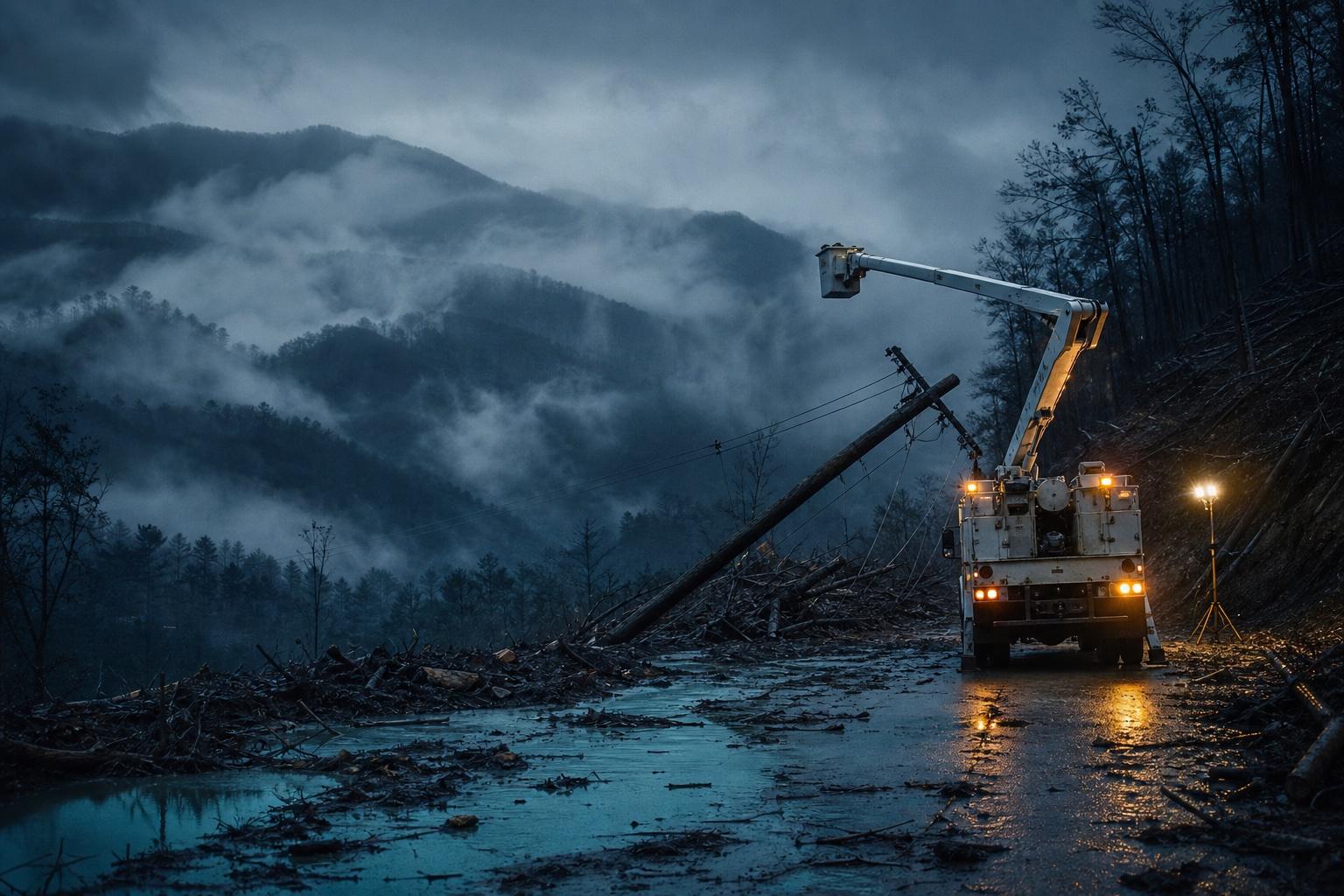
The speaker is a Duke Energy lineworker. He is describing the conditions under which his team — and three hundred others like it — restored electricity to the Carolinas after Hurricane Helene made landfall as a Category 4 storm in Florida's Big Bend on 26 September 2024 and then drove north into the Appalachians as a rainfall event of unprecedented intensity: 20 to 21 inches over three days across the mountains of northwestern North Carolina, on ground that was already soaked from a predecessor rainfall event a few days earlier.
The number that gets quoted most often about Helene is the death toll — at least 250, the deadliest hurricane in the United States since Katrina. The number that gets quoted least often is the one that matters for this post: in Duke Energy's territory alone, 370 substations were damaged or destroyed. The Spruce Pine, North Carolina lineworker quoted above worked alongside a team "just over 300 strong" for roughly 21 days in a community where, on arrival, there were "no lights, no cell phone service and no water in the entire area."
That community was not unusual. It was representative.
This post is about the second-order story Helene wrote that almost no one has finished reading: a story not about power restoration, but about coordination of the workforce doing the restoring. About a workforce that, in 2024, became the most operationally isolated population on the North American continent — and the tools that existed to coordinate them, and the utilities that did not have those tools deployed when the storm hit.
The geometry of the outage
Helene's path through the Carolinas was a worst-case fit to a worst-case terrain. The North Carolina mountains are densely forested, deeply ravined, and crossed by hundreds of small bridges over creeks that, on a normal week, are ankle-deep. On the morning of 28 September 2024, many of those bridges no longer existed. Duke Energy reported within 48 hours of landfall that more than 1.1 million customers had been restored — and that around 904,000 remained without power, almost all in the western portions of each state. The headline number was a win. The geographic concentration was the warning.
In communities like Spruce Pine, Asheville's outer suburbs, and Buncombe County's mountain townships, the outage geometry compounded. Power was down. Cell service was patchy or absent. Water systems had failed. Roads were destroyed or blocked by mudslides. Verizon reported on 2 October that they had recovered coverage to 60% of affected regions, but that mountain terrain and inaccessible roads meant they were "resort[ing] to drones to provide temporary coverage." T-Mobile distributed Wi-Fi connectivity stations and mobile generators. Starlink offered free service for 30 days — to anyone who already owned the equipment, or could receive a $349 dish via a road network that no longer reached them.
The customer experience of this was awful. The field-operations experience of this was worse.
The crews who restored power were themselves disconnected
Here is the part of the story that almost nobody outside the utility industry hears.
In the first three weeks of October 2024, more than 50,000 lineworkers from utilities across the United States and Canada were deployed to the Carolinas, Georgia, and Florida under the mutual-aid framework that the US electrical industry has refined since Hurricane Andrew in 1992. They drove in convoys. They slept in base camps. They worked 16- to 18-hour days. Some of them — the Duke Energy crew that started in Charlotte and rotated through Spruce Pine — were deployed for 21 consecutive days. Some, across the broader Helene response, worked something closer to 40 straight days before rotating home.
Throughout most of that period, the cell network in the areas they were working was down or unreliable. The radios they were using were the same radios they had used in 2010 with minor upgrades — and the radio coverage maps were drawn for a network of substations and repeaters that no longer existed, because the storm had destroyed many of them.
Coordination ran on satellite phones — when batteries lasted, when sight-lines were clear of the canopy, when the dispatch desk was reachable. It ran on paper-and-handheld at base camp. It ran on the assumption that a crew that didn't check in by the radio cadence had probably just lost sight of its repeater, not crashed into a ravine.
That assumption held — mostly. There were no headline crew-loss incidents during the Helene response. But "mostly" is not a system. Mostly is what's left when a system is absent. The fact that no crew was catastrophically lost is a credit to the lineworkers themselves and to the field supervisors who used institutional memory and personal judgement to fill the coordination gap. It is not evidence that the gap doesn't exist.
The 911 problem and the secondary outage cascade
If the crews were the operationally invisible population, the residents they were restoring power to were the operationally invisible casualties.
On 29 September 2024, eleven counties in western North Carolina had no functioning cellular service. Across the region, residents who needed to reach 911 either could not, or had their calls bounced through routings that took them to dispatch centres hours away. The Newton communications center, which normally handles dispatches for one county, processed over 6,000 calls in the immediate aftermath of the storm.
Emergency Support Function 2 (ESF-2) — the federal mutual-aid framework for communications — mobilised strike teams to deploy satellite and radio gear into the worst-affected counties. Those strike teams were, themselves, distributed field workforces operating in degraded-connectivity environments, doing the same job (restoring connectivity) on a different layer (telecoms infrastructure rather than power lines), with the same coordination challenges.
By April 2026, eighteen months after the storm, Verizon and T-Mobile were still upgrading their storm-response systems — deploying more portable cell sites, hardening rural towers, expanding their drone-based temporary-coverage fleets. That work continues. The original infrastructure has not been fully rebuilt; large parts of it have been replaced by next-generation systems that are themselves still being tuned.
What the audit trail looks like
If you are an operations director at a utility, an electrical contractor, a mutual-aid coordinator, or a state emergency-management agency, the question Helene puts to you is not did the lights come back on? The lights came back on. The question is:
Eighteen months after the storm, can your organisation produce a per-crew, per-shift, per-incident timeline of where every deployed worker was, when their last check-in occurred, who was awake and responsible for them at the time, and what the response was when a check-in was missed?
For most utilities, the honest answer is: we have a power restoration timeline. We have a territorial deployment map. We have base-camp manifests. We do not have a per-worker timeline in the sense above. We have it for the workers who were injured or fatalitied (a small number), because OSHA requires it. We do not have it for the workers who were operating in degraded conditions for 21 days (a large number), because nobody was asking for it then.
OSHA may yet ask for it. The mutual-aid framework's after-action reviews already do, in some jurisdictions. Insurance carriers are starting to.
The lights came back on. The question is whether anyone has a per-crew timeline for what happened to the people who turned them back on.
What changes between Helene and the next event
The hurricane season of 2024 was not an anomaly. Hurricane Milton made landfall in Florida twelve days after Helene, on 9 October 2024 — a Category 3 storm with its own catastrophic flood and tornado profile, requiring a second wave of mutual-aid deployments before the first wave had finished rotating home. The 2025 season was lighter, but ended with a damaging late-season storm in late October that re-strained the same crews. The 2026 season is now starting.
The shift from available to adopted — for the coordination platforms that handle the four artefacts the previous post discussed — is not free. It requires:
- A baseline mobile fleet at the field-supervisor level (already broadly in place at major utilities).
- Offline-first mobile applications that work for days at a time without backhaul (this is the part that gates everything; we'll write about it specifically in a later post).
- A per-worker timeline view that an incident commander can query in seconds.
- Integration with the existing mutual-aid command-and-control infrastructure (ICS-204 forms, base-camp manifests, OSHA reporting) so it complements rather than replaces.
- Training of the field-supervisor cohort, who are the actual decision-makers in a deployed environment.
None of those steps are particularly difficult. None of them are cheap or fast. All of them require senior leadership in the utility — or in the mutual-aid coordinating body — to decide that the per-worker timeline is worth budget and procurement attention before the next storm, not after.
That decision is the one that gets made or not made in the eighteen months between events. It is being made right now, by every utility in the southeastern United States, for the 2026–2027 hurricane window. The ones who decide to close the gap will know what their crews experienced during the next event in a way that the Helene generation did not. The ones who don't will write the next forty-days-in-the-dark retrospective.
Why this matters in Australia
This post is anchored in the US because Helene is the most legible recent example of the dynamic at scale. The dynamic, however, is not US-specific.
Australia's distributed workforces — bushfire response crews, post-cyclone reconstruction teams, remote mining operations, FIFO services contractors, far-north health responders — operate under the same coordination geometry. The 2019–2020 Black Summer fires, the 2022 Lismore floods, Cyclone Jasper in December 2023, and Cyclone Narelle two months ago all produced workforces operating for days or weeks in degraded-connectivity environments. The same available-but-not-adopted gap exists here, with state-specific tooling rather than federal mutual-aid frameworks but the same underlying question: can the organisation produce a per-worker timeline for the disrupted window?
For most Australian operators, the honest answer in May 2026 is the same as it was in the US in October 2024. That's the gap. It's closeable.
Sources: T&D World, "Hurricanes Helene and Milton: One Year Later" (2025). Duke Energy News Center recovery updates, September–October 2024. NOAA National Centers for Environmental Information, Storm Events Database. Wikipedia, "Effects of Hurricane Helene in North Carolina." ABC11 Raleigh-Durham, Helene recovery updates, April 2026. Federal Emergency Management Agency ESF-2 mobilisation records, October 2024.