When then-Prime Minister Malcolm Turnbull announced Snowy 2.0 in March 2017, the headline numbers were that the project would cost about $2 billion and be operational by 2021. Nine years later, in May 2026, the project is roughly 70% complete, the official budget sits at $12 billion (with a further cost-reassessment under independent review and likely to land north of that), and the revised first-power target is end-December 2028 — with independent assessments suggesting first power may slip to 2029 or 2030.
That's a 6× cost overrun and a 7-to-9-year schedule overrun. The story has produced one of the longest-running political and procurement controversies in Australian infrastructure history. Snowy Hydro's CEO, Dennis Barnes, who took the role in 2023, has been straightforward about it: "we didn't get this cost forecast right."
The cost story has been written about exhaustively. This post is about the operations story sitting underneath it — because the operations story is the part that's transferable to every other multi-site builder, regardless of whether they're cutting alpine tunnels or building suburban apartments.
What's actually happening underground
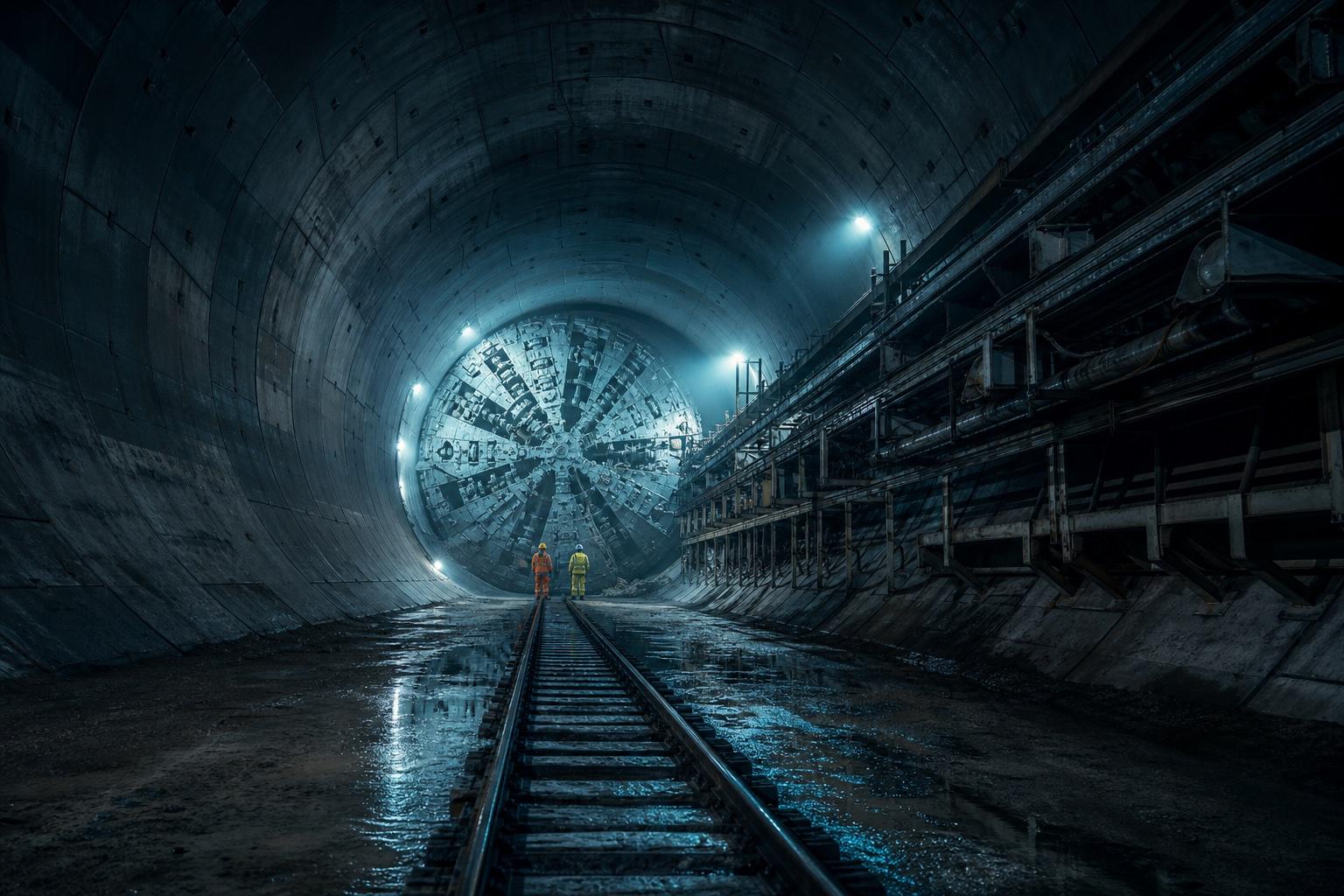
The headline engineering challenge of Snowy 2.0 is a network of 27 kilometres of tunnels carved through the Snowy Mountains, almost a kilometre underground, connecting the existing Tantangara reservoir to Talbingo via an underground pumped-hydro power station. That work has been delivered through three (now four) tunnel-boring machines, all named after pioneering women in engineering and aviation:
- TBM Lady Eileen Hudson — successfully broke through into the underground cavern complex in early 2026, completing her work after excavating a 2.85-km access tunnel and a 6-km tailrace tunnel.
- TBM Kirsten — excavated the emergency, cable and ventilation tunnel at Lobs Hole.
- TBM Florence — the 143-metre-long machine assigned to excavate 14.9 km of the 17-km headrace tunnel. Florence got stuck in the Long Plain Fault Zone — an 850-metre stretch of fractured, unstable geology — for months in 2024 and 2025. As of mid-2026, Florence is "past the halfway point" of her 15-km journey.
- TBM Monica — the fourth and newest machine, a $75 million, 178-metre-long, custom-built TBM commissioned in February 2026 specifically to attack the Long Plain Fault Zone from the opposite end and meet Florence in the middle.
Barnes, defending the decision to acquire Monica, was explicit: "In the event that Florence got stuck, we would be looking at a serious delay to the project." That sentence is the engineering frame on a $75M procurement decision. The operations frame is what surrounds it: at any given week of Snowy 2.0's construction since 2019, there have been thousands of distinct work fronts active across the broader project, spread across alpine sites separated by sometimes hours of driving, run by a principal joint venture (Future Generation JV — Webuild, Clough, and Lane WBHO) with subcontractors, design consultants, geotechnical engineers, and Snowy Hydro's own engineering and operations teams all in the mix.
The Monica decision was made because Florence got stuck. The fact that Florence's stuck-ness propagated immediately into a serious delay — rather than being absorbed in days by parallel work on adjacent fronts — is the operational story.
What every multi-site builder eventually faces
The shape of Snowy 2.0 is unusual in scale, not in kind. Every multi-site builder eventually faces some version of the same operational geometry:
- Multiple work fronts, geographically separated. Builders running a portfolio of 5, 10, 30 jobs across a metropolitan area or a state face this in shrunken form. Mega-infrastructure faces it in spatial extremis.
- Workforces that mix direct-hire, subcontract, and consultant labour. Site supervisors at a typical commercial build run a crew of 30–50 directly, oversee 5–20 subcontract trades, and field consultant visits (engineers, certifiers, surveyors, environmental monitors). Snowy 2.0 runs the same shape at 100× scale.
- Critical-path tasks that propagate failure laterally. When one trade falls behind, the trades downstream of it lose their ability to start on time. When TBM Florence got stuck, every downstream tunnel-completion task slid right; when a building site's basement waterproofing fails inspection, every above-ground trade slides right by the same window.
- Safety and compliance obligations that don't recognise scale boundaries. A construction-induction (white-card) breach on a remote alpine portal is exactly the same legal exposure as the same breach on a suburban duplex. The principal contractor's system of work has to cover both.
- Documentation that has to survive an audit decade later. Construction is one of the longest-tail industries for documentation requirements. Building defects, latent-condition disputes, workers' compensation claims, and safety investigations can land years or decades after the work is complete. The audit trail has to outlive the project.
The bonus controversy and what it reveals about visibility upstream
In May 2026, ABC News reported that Snowy Hydro executives were paid more than $1.2 million in bonuses. The bonus, paid in September 2025, came the month before Snowy Hydro confirmed the project would exceed its $12 billion budget by an amount the company has not yet disclosed.
The political controversy is its own story. The interesting operations question is: how confident was the executive team about the cost trajectory at the time the bonus was approved? Snowy Hydro told the ABC its principal contractor, Future Generation JV, is undertaking a "line-by-line" cost reassessment, to be verified by independent construction-cost experts. That reassessment has been ongoing through the first half of 2026.
A line-by-line cost reassessment, six years into a project of this size, is a confession that the operational visibility into the cost base wasn't real time, or accurate enough to be relied on for an executive bonus decision in September 2025. The cost issue is downstream of the visibility issue.
This is not unique to Snowy 2.0. It is, in our reading, the single most common pathology of multi-site builders. The cost system shows what was booked against work-orders three weeks ago, with corrections; the schedule system shows what was promised six months ago, with revisions; the safety system shows what was reported last week, with escalations. Nowhere is there a single operational view that says here is the current state of every active work front across the whole network, and here is what the people on those fronts experienced today.
When that view doesn't exist, decisions at the executive level — bonuses, sign-offs, public commitments — get made on the basis of the cost system, the schedule system, the safety system, and a series of conversations between senior executives. Each of those is partial. The integration layer that would make them coherent is, again, the thing most operators haven't built.
The cost issue is downstream of the visibility issue. The Monica decision could be made cleanly because the consequence of Florence getting stuck was operationally visible. Most decisions don't have that clarity.
The Long Plain Fault Zone as an operations lesson
Florence's stuck-ness in the Long Plain Fault Zone is, on the engineering side, a story about ground conditions, TBM design choices, and the limits of pre-construction geotechnical surveys. On the operations side, it's a story about what happens when the available data on a critical-path task degrades faster than the management response can keep up.
The reason Monica was procured as a $75M emergency intervention — rather than as a slow, careful, "let's wait and see how Florence does" decision — is that Snowy Hydro's operations team built (over the course of 2024 and 2025) a sufficiently sharp picture of how stuck Florence actually was and how long the schedule slippage would be if Florence continued at her then-rate. That picture, by the time it was sharp enough to act on, was the basis for the procurement decision.
The interesting question for the rest of construction is: how long did it take that picture to become sharp? How many weeks of "Florence is going slower than expected, but it might pick up next week" passed before the operations team had a confident enough projection to ask the board for $75 million for a new machine?
We don't know the answer. The CEO's public statements suggest the decision was made in August 2024 — meaning Monica's procurement, manufacturing, transport, and commissioning then took eighteen months (Monica started boring on 19 February 2026). For an emergency intervention, eighteen months is the time it took. For the decision to make the intervention, the operational data trail apparently caught up by mid-2024, roughly a year into Florence's worst stuck-ness.
A year is a long time at a $12B project. The picture should have sharpened faster.
What this means for a typical Tier 1 or Tier 2 builder
If you are an operations director or project director at a Tier 1 or Tier 2 Australian builder — running, say, 15 to 50 simultaneous sites at any given time, across NSW, Victoria, Queensland, and WA — the Snowy 2.0 lessons translate as follows:
-
The single operational view exists or it doesn't. Either there is a dashboard a site-services general manager can open and see the current state of every active site (who is on it, when did they arrive, what's the current incident state, what's the trade-progress state), or the GM is reconstructing that picture from twelve different sources every Monday morning. The first is a system; the second is a heroic effort that fails when the GM is on leave.
-
Inter-site escalation is the leading indicator. When a problem on Site 23 needs to escalate to a regional operations manager who is responsible for Sites 10–30, the friction in that escalation is the friction in the system. If escalation routinely happens via phone-tag and email-trail, the time the system takes to surface a problem is the period during which the problem grows. Snowy 2.0's stuck-Florence period grew for as long as the escalation path was slow.
-
Audit-trail is not a documentation exercise. It is a real-time operations artefact. If your incident logs, your daily reports, your site-attendance records, and your subcontractor work-order completions are produced once a day at end-of-shift by site administrators typing things into a spreadsheet, you have a documentation trail. You don't yet have an audit trail. The difference matters when a $1.2M bonus is paid in September and the bad cost news arrives in October.
-
The product category exists; the question is integration not build. Construction has more software vendors than almost any other industry in Australia, with the partial exception of mining. The reason most operators don't have the single operational view is rarely that no vendor sells the right product. It is that the integration project (between Aconex / Procore / HammerTech / scheduling / payroll / their journey-management / their incident-reporting / their site-attendance / their subcontractor-work-order systems) is a project nobody has owned end-to-end. The integration is what's missing.
A specific operational story to imagine
A Tier 2 commercial builder running 22 active sites across Sydney's eastern and southern suburbs. The state operations manager — call her Anna — opens her dashboard at 7:15am on a Tuesday. She sees:
- Twenty-two sites green. Twenty-one of them are at expected start-of-day staffing. One, Site 14 (a high-end apartment build at Maroubra), is showing only 12 of the 21 expected site-attendees through the gate-scanner by 7:00am.
- A drilldown shows that the missing nine workers are all from one subcontractor — a plumbing crew. Their contracting company's truck-tracking integration shows the truck is parked at their depot in Hurstville, not yet moving.
- A second drilldown shows that the same subcontractor was 40 minutes late starting yesterday, and 25 minutes late the day before. The trend is widening.
- Anna doesn't have to make a phone call to know there's a problem. She has to make a phone call to fix it — and she calls the right person (the subcontractor's account manager, with whom she has a documented escalation protocol) on the first call.
- The escalation goes into the system, time-stamped. By Friday, the same dashboard shows whether the corrective action held.
That is the operational layer working. Most Tier 2 builders, at most metropolitan Australian state operations, do not have it. They have phone-tag, WhatsApp, and a state operations manager who reconstructs the picture from twelve sources every morning while drinking her first coffee.
Snowy 2.0, at $12 billion and growing, is the version of this same gap at extreme scale. The fix is, again, the integration layer. The product category for it exists.
What we'd recommend looking at
-
Pick one regional cluster of sites. Run a one-week experiment: can you produce, on demand, the current state and the prior-day-end state of every site in the cluster, by 8am the next morning? If not, the gap is named.
-
Time the escalation. When something happens on a site that needs to reach a regional or state-level decision-maker, measure how many minutes the path takes. Anything over 60 minutes is, by current 2026 standards, a system fault, not a process feature.
-
Test the worst case. Simulate a stuck-Florence scenario on one of your sites — a critical-path task that goes 20% slower than planned for a month. How long does it take your operational layer to surface the projection clearly enough that someone at the principal-contractor executive level can make a decision about whether to intervene? At Snowy 2.0 it took roughly a year. At a $12B project, that's expensive. At a $150M project, it's potentially fatal to the program.
-
Map the integration project. If you have Aconex (or Procore), HammerTech (or SitePass), Cintoo or similar reality-capture, your own scheduling, your own payroll, and a constellation of safety apps, the project to make them produce a single operational view is real, scopable, and has been done elsewhere. We are one vendor in that space; there are others. The question is whether the integration project gets owned.
Sources: ABC News (2 February 2026) "Snowy 2.0 defends timeline as it launches new $75 million machine amid cost blowout review"; ABC News (22 May 2026) "Snowy Hydro bosses paid more than $1.2m in bonuses as renewables project costs spiral"; Snowy Hydro News Centre, "Major breakthrough achieved as TBM momentum builds" and prior commissioning releases; tunnelbuilder.com Snowy 2.0 project update, 28 April 2026.